Vardavar: The Great Armenian Festival of Waters and Light
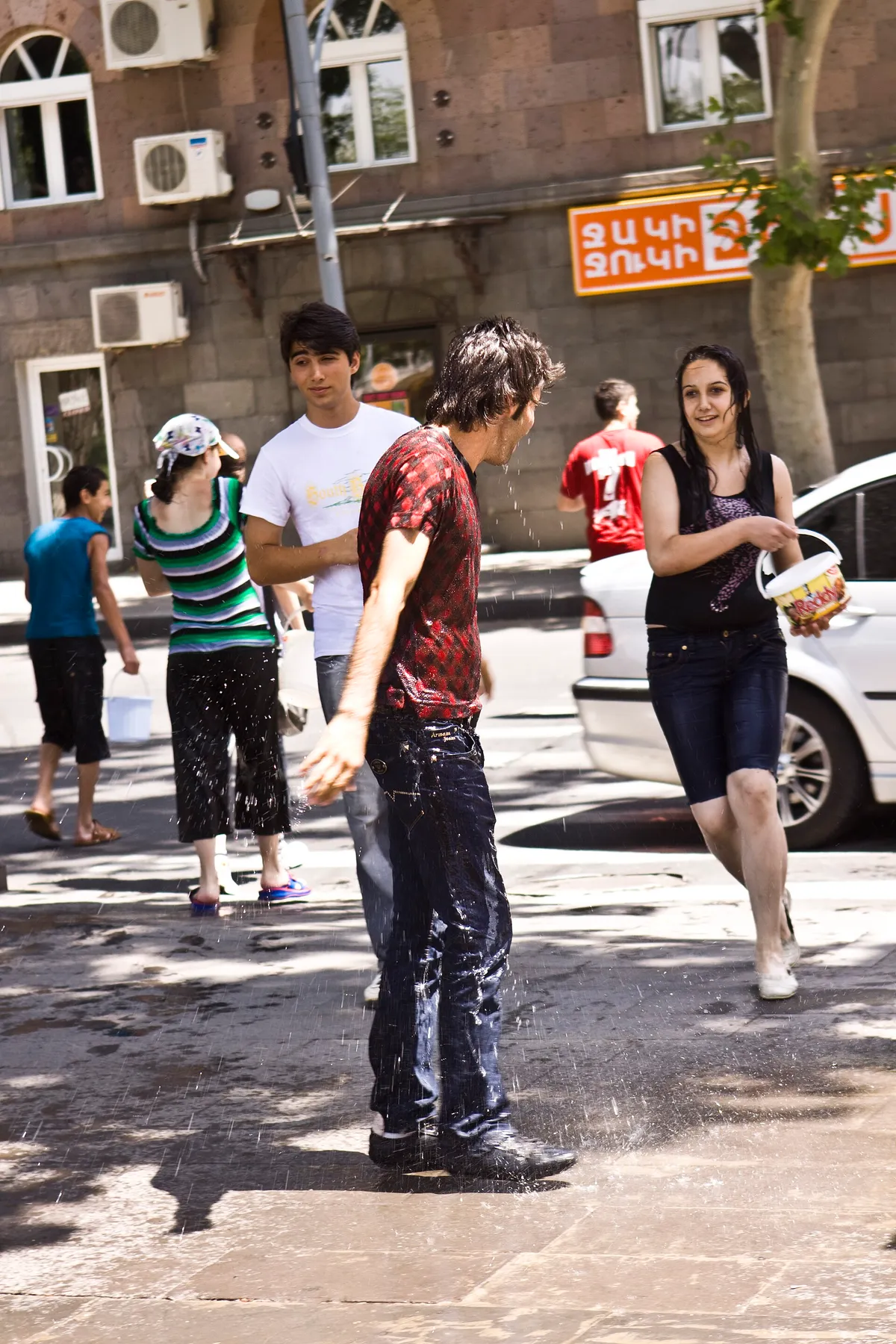
Inscribed on the list of Armenia's intangible cultural heritage, the festival of Vardavar (or Vartavar) is among the most vibrant celebrations and dearest to the hearts of the Armenian people. Punctuated by laughter, cheers, and generous splashes of water drenching passersby and loved ones, this summer day transforms towns and villages into an arena of collective joy. Yet behind this popular game that children affectionately call djrotsi, echoes a much older tradition, where pre-Christian mythology intertwines with the solemnity of the Apostolic faith.
From Ancient Altars to Mount Tabor
Long before the Christian era, Armenia celebrated nature's abundance, the end of the harvest, and the tutelary powers of water at the height of summer. Vardavar was then closely associated with the worship of Astghik, goddess of water, beauty, love, and fertility, as well as the goddess Anahit. Worshipers offered ears of grain in temples, made libations of wine, and sacrificed lambs near mountain springs to pray for rain and protect crops from the ravages of drought, hail, or locusts.
With the advent of Christianity, the Armenian Apostolic Church integrated this celebration into the heart of its liturgy. Saint Gregory the Illuminator first chose to set the Feast of the Transfiguration of Christ on the first day of the Armenian calendar, the 1st of Navasard (August 11), thereby Christianizing the great gathering once held at the sanctuaries of Ashtishat and the temple of Innaknya. Later, in 551, Catholicos Movses II linked the feast to the Paschal cycle, moving it to the seventh Sunday after Pentecost. As one of the five major feast days (Daghavar) of the Armenian Church, Vardavar takes place exactly 98 days (fourteen weeks) after Easter, between June 28 and August 1. It is preceded by a week of fasting and immediately followed on Monday by Merelots, a memorial prayer service for the repose of the departed.
The Symbolism of Water, Roses, and Apples
At the center of Vardavar rituals stand lustral water, flowers, and the first fruits of summer. According to biblical accounts handed down by tradition, splashing one another also recalls the memory of the Great Flood, when the patriarch Noah, having descended from the ark on Mount Masis toward Nakhchivan, commanded his descendants to sprinkle water on one another and release doves in memory of the salvation granted to humanity.
The name of the festival itself has sparked numerous studies. Popular tradition sees it as the union of vard (rose) and var (burning or flaming), recalling the armfuls of roses presented to Astghik or the radiant beauty of Christ transfigured before the apostles Peter, James, and John on Mount Tabor. The scholar Ghevond Alishan linked this etymology to the cult of the goddess, while linguist Grigor Ghapantsyan in 1940, followed by K. V. Melik-Pashayan in 1963, identified a Hittite root combining vadar (water) and arr (to wash, to sprinkle). Other researchers, such as Sukias Paronyan or A. E. Petrosyan, explored avenues linked to fire worship or Indo-European roots.
Among the enduring customs was the prohibition against eating apples before Vardavar: only on the day of the festival were the first fruits of the season tasted. In Shatakh, young people would stack wood on the eve of the feast and light bonfires around which they roasted these first apples, dancing until dawn.
Mountain Sanctuaries and Regional Traditions
Vardavar has always been a major pilgrimage festival. Believers climbed the heights to pray beside water springs: Mount Khustup in Zangezur gathered the faithful from Kapan and Meghri, while others ascended Mets Ishkhanasar, Mrav, Mets Kirs, or Dizapayt. More than one hundred and sixty sacred sites and chapels across Armenia and Artsakh hosted these ritual processions, including the famous monastery of Surp Karapet in Taron, renowned throughout the Near East.
Each region cultivated its own nuances: in Lori, the water splashed was scented with rose petals and aromatic herbs; in Syunik, fruit trees were watered to ensure bountiful harvests; in Artsakh, families gathered around springs renowned for their healing properties. In localities of Tavush, Lori, or Vardenis, local tradition sometimes maintained the celebration on the Sunday following July 20 or 22, when agricultural work had concluded.
A Cultural Treasure Passed Down to Future Generations
This ritual richness inspired the greatest masters of Armenian literature. Movses Khorenatsi dedicated homilies to the mystery of Vardavar, the philosopher Anania Shirakatsi and Saint Nerses Shnorhali composed sublime liturgical hymns (sharakans), and Saint Gregory of Narek immortalized this radiance in his celebrated poetic song (Tagh Vardavari). In medieval illumination, as on the ancient fresco of the Church of the Holy Cross of Aghtamar, the scene of the Transfiguration depicts Christ within a luminous mandorla, surrounded by Moses and Elijah.
Today, the festive spirit remains intact. Since 2014, the Federation of Youth Clubs of Armenia (FYCA) has organized the Vardavar International Festival at the historical sites of Garni and Geghard, blending craft pavilions, circle dances (shurdjpar), tastings of gata, and folk songs performed notably by the Nairyan Vocal Ensemble. From Russia to Glendale, the diaspora perpetuates this unbreakable bond with the ancestral land.
To continue celebrating and sharing this unique heritage, lovers of our traditions are warmly invited to gather at the Armenian Culture Fest, which will be held on November 7, 2026 in California.
Don’t miss : Armenian Culture Fest — Saturday, November 7, 2026, California
Sources
- Vartavar (Wikipedia fr)
- Vardavar (Wikipedia en)
- Վարդավառ (Wikipedia hy)
- Вардавар (Wikipedia ru)
- Armenia to host Vardavar International Festival 2015 (PeopleOfAr)
- Today Marks Vardavar (PeopleOfAr)
Texts from Wikipedia (CC BY-SA 4.0) and Wikisource (CC BY-SA 3.0), used as sources.
Written with an AI tool from the sources cited and checked by our editors; translated automatically from the reviewed French text.
Read next
 The Art of the Armenian Carpet, a Millenary Heritage Woven with HistoryFrom ancient origins to modern workshops, discover the art of the Armenian carpet, a textile treasure of symbols, craftsmanship, and history.
 Kochari: History, Steps, and Memory of an Emblematic DanceDiscover Kochari, a circle dance born in the Armenian highlands, from its unique movements to its inscription on UNESCO's cultural heritage list.
 Khor Virap Monastery: Spiritual Sentinel Facing Mount AraratDiscover the history of Khor Virap, Armenia's major sanctuary where Gregory the Illuminator was imprisoned before the kingdom's conversion in 301.