Komitas: The Rediscovered Voice of the Armenian People
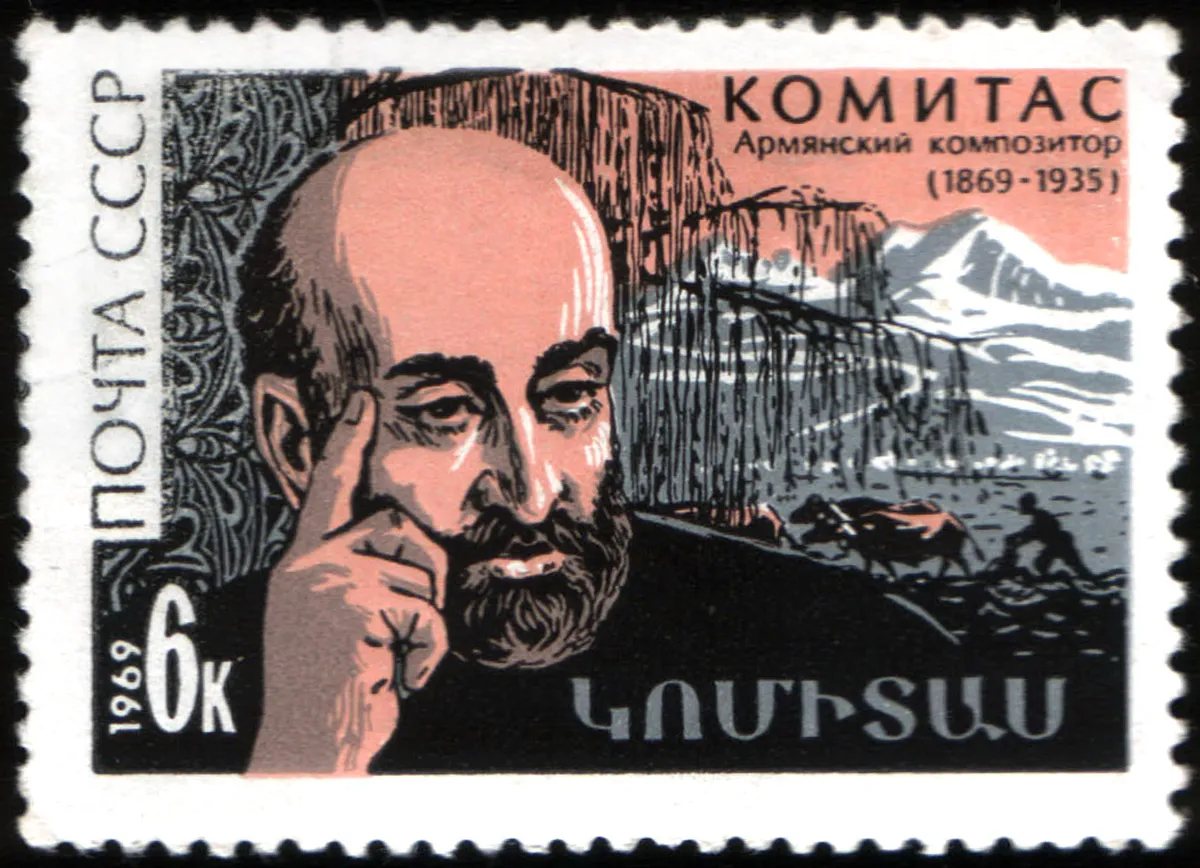
Born Soghomon Soghomonian on September 26, 1869, in Kütahya, in the Ottoman Empire, the man who would become Father Komitas carried within him the history of a people and their songs. Left motherless at just six months old and an orphan upon his father's death at the age of eleven within a Turkish-speaking family originally from Goghtn, the young boy experienced early deprivation. Nothing seemed to destine him for such a musical fate, except for a remarkable voice noticed during Sunday services. In 1881, the prelate of his region brought him to the Holy See of Etchmiadzin, where Catholicos George IV had founded a seminary open to a few orphans. Although he had not yet mastered the Armenian language, Soghomon moved the Catholicos by intoning the hymn Looys zevart. Admitted to the Gevorkian Seminary, he learned Armenian, was introduced to choral singing under the direction of Kristapor Kara-Murza, and developed a passion for the ancient neumatic notation of the khaz.
Ordained a hieromonk in 1894 under the religious name of Komitas—in homage to a 7th-century catholicos and musician—and elevated to the rank of vardapet in 1895, he subsequently dedicated his life to the service of popular and sacred melodies.
At the Source of Folk Song and Liturgical Modes
Conscious of the distortion suffered by traditional liturgical monody in the face of harmonic influences from the West, Komitas made it his mission to recover the authentic musical modes of the Armenian liturgy. Supported by Catholicos Mkrtich Khrimian and with financial assistance from the patron of the arts Alexander Mantashev, he went to complete his training in Tiflis under Makar Yekmalyan, then settled in Berlin between 1896 and 1899. There, he studied composition, piano, and musicology at the Frederick William University with specialists such as Oskar Fleischer, Heinrich Bellermann, and Max Friedlaender, and became one of the first members of the International Music Society.
Upon his return to Etchmiadzin, Komitas traveled across the Armenian countryside with his students to collect the words and melodies of the peasantry. His approach proved pioneering for ethnomusicology: he observed the genesis of songs in daily life, transcribed rural polyrhythms, and meticulously annotated even the gestures of the singers. More than three thousand melodies were gathered in this manner—of which about a thousand survive—immortalizing secular traditions, wedding songs, lullabies, and dance tunes. As early as 1903, he published A Thousand and One Songs, while also opening himself to other cultures of the region with the publication, in 1904, of a pioneering collection of Kurdish songs. This undertaking, however, met with incomprehension from a portion of the conservative clergy of Etchmiadzin, who criticized his interest in rustic and secular melodies.
Constantinople and the Influence of Armenian Art
In 1910, eager to broaden his audience and escape these clerical tensions, Komitas settled in Constantinople, in the Pangaltı district, where he lived for a time alongside the painter Panos Terlemezian. There, he founded the Gusan choir, bringing together hundreds of singers and training several disciples in musicology, including Barsegh Kanachian and Mihran Toumajan. His choirs performed liturgical and folk works harmonized for four voices, revealing the nobility of Armenian musical heritage to a broad urban public.
Komitas also shared his knowledge through lectures and concerts across Europe. In Paris and Berlin, his performances aroused great admiration. In 1906, in the pages of the Mercure Musical, musicologist Louis Laloy praised an art of great sweetness and meditative fervor. In 1912, the composer completed the compilation of the Divine Liturgy (Badarak), whose choral version achieved lasting prominence. Two years later, he attended the congress of the International Music Society in Paris, where his papers and vocal performances drew the attention and praise of musicians such as Claude Debussy.
The 1915 Arrest and Exile into Silence
This intense creative trajectory was violently interrupted by the First World War. On the night of April 24, 1915, Komitas was among the Armenian intellectuals arrested by Ottoman authorities in Constantinople. Imprisoned and then placed on a deportee train, he was taken to the detention camps of Ayash and Çankırı in Anatolia. During this journey and his imprisonment, he suffered physical violence and witnessed the anguish of his companions, many of whom were executed.
Thanks to outside interventions—including those of American Ambassador Henry Morgenthau and prominent Turkish intellectual figures—Komitas was among a small group of detainees pardoned by order of Talaat Pasha and permitted to return to Constantinople in May 1915. Upon returning home, he found his library looted and his manuscripts scattered. Deeply scarred by the persecutions he had witnessed and the massacres of his compatriots, he developed severe post-traumatic stress disorder. Although he still managed to compose the Armenian Dances in the spring of 1916, his mental state deteriorated rapidly, locking him in mutism.
Admitted to the Hôpital de la Paix in Şişli in the autumn of 1916, he left Constantinople for France in 1919. Treated first at Ville-Évrard, he spent the final years of his life in a psychiatric hospital in Villejuif, where he died on October 22, 1935.
An Enduring Presence in World Heritage
In 1936, Komitas's ashes were transferred to Yerevan to rest in the Pantheon that now bears his name. The legacy of his work remains immense: by recording the songs of a society largely annihilated in 1915, he preserved a core pillar of Armenian cultural memory.
His entire manuscript corpus is now inscribed on the UNESCO Memory of the World Register. In Yerevan, the Komitas State Conservatory, a major avenue, and a museum keep his memory alive, while his portrait has adorned the 10,000-dram banknote since 2018. Chamber ensembles, singers, and pianists continue to record and perform his transcriptions and compositions worldwide, keeping the resonance of his work intact.
Sources
Wikipedia texts under the CC BY-SA 4.0 licence, used as sources.
Written with an AI tool from the sources cited and checked by our editors; translated automatically from the reviewed French text.