The Kochari: History, Steps, and Memory of an Emblematic Dance
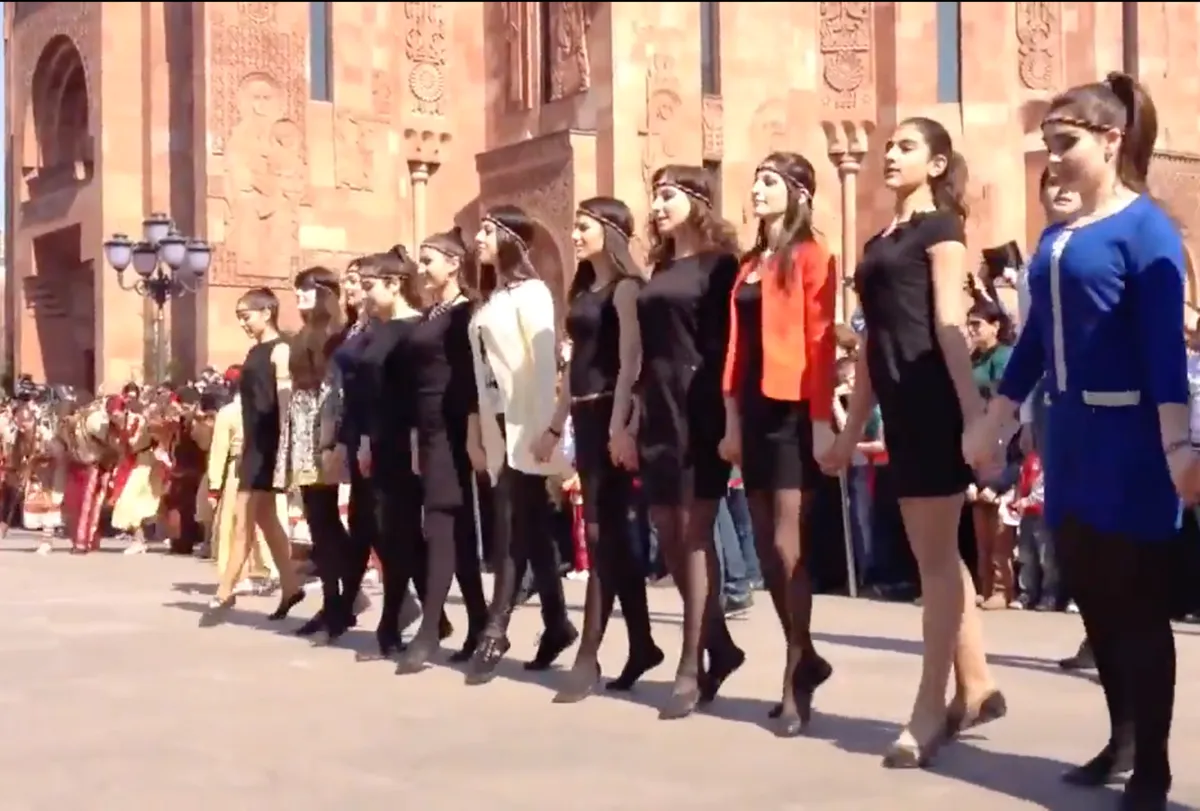
The kochari (Քոչարի) is one of the most vibrant expressions of traditional Armenian arts. Originating in the Armenian Highlands, this collective circle dance has been practiced by Armenians for over a thousand years. While embodying a major part of the region's musical and choreographic heritage, the term also has distinct resonances across borders and even refers, in an entirely different register, to a homonymous Egyptian culinary practice also recognized by UNESCO.
Martial Gestures and Millenary Roots
Practiced by both men and women, the Armenian kochari was designed to impress and intended to be intimidating. In each region of the Armenian Highlands, a specific variant once existed, distinguished both by its performance style and its own music. A mention from repertoires also associates a foundation or creation with the year 1800.
The choreographic structure follows unique physical codes. As analyzed by John Blacking, the kochari brings dancers together side by side, holding hands, to form a circle whose tempo oscillates between a moderate measure and a fast rhythm. During the dance, participants imitate the leaping of goats. Movements in which performers squat and mime headbutting an imaginary opponent are followed by vigorous high jumps.
Throughout its evolution, the practice incorporated new figures, such as the “tremolo step,” which consists of shaking the entire body. The Armenian etymology directly explains this bodily mechanics: the term “kochari” literally means “come to the knee,” resulting from the combination of gudj (or goudj, գուճ) meaning knee, and ari (արի), which translates to “come.”
Historical Path and Regional Variations
In terms of its historical and territorial trajectory, the dance spread to the eastern part of Armenia after the Armenian Genocide. Alongside the Armenian tradition, variants are danced today by other populations, notably Assyrians and Pontic Greeks.
Among Pontic Greeks, the dance is known as Kotsari (Κότσαρι) and falls, like the Armenian kochari, into the category of vigorous and martial dances. Originally performed in a closed circle to an even 2/4 rhythm, it derives its Pontic name from the terms kotsi (or kots, from medieval Greek kottion, meaning heel) and airo (to lift or raise). Together, it means “to lift the heel,” the heel being considered by the Greeks as the primary part of the foot engaged by the dancer.
These traditions have garnered institutional attention on a global level. The Armenian kochari was thus inscribed in 2017 on UNESCO's List of Intangible Cultural Heritage in Need of Urgent Safeguarding.
Sources
Wikipedia texts under the CC BY-SA 4.0 licence, used as sources.
Written with an AI tool from the sources cited and checked by our editors; translated automatically from the reviewed French text.
Read next
- The Art of Khachkars: When Armenian Stone Becomes the Tree of LifeDiscover the history, symbolism, and fate of khachkars, the Armenian cross-stones inscribed on UNESCO's Intangible Cultural Heritage list.
- Komitas: The Rediscovered Voice of the Armenian PeoplePriest, composer, and ethnomusicologist, Komitas saved and reinvented Armenian music before being broken by the tragedy of 1915.