Lavash, Millennia-Old Breath and Emblem of the Armenian Table
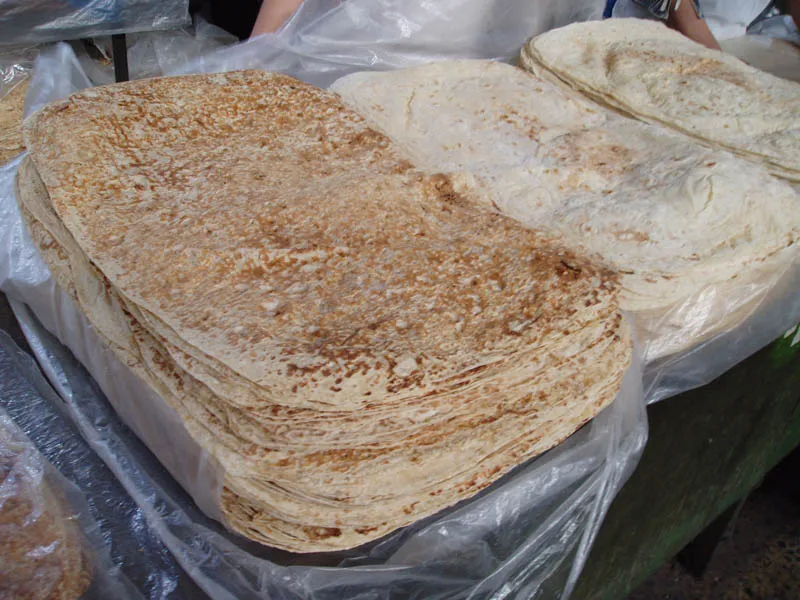
A thin flatbread, flexible fresh from the fire and crisp when dried, lavash (Armenian: լավաշ) is much more than a simple staple: it is the nourishing heart of Armenian culture. Prepared from elementary ingredients—wheat flour, water, and salt—this flatbread baked against the scorching walls of a clay oven has accompanied everyday domestic life since time immemorial.
Collective Know-How Centered Around the Tonir
Making lavash relies on shared craftsmanship and genuine collective organization. In Armenian tradition, this task brings together several women from the household or community. The dough, kneaded in a large wooden trough called a tasht, can be prepared unleavened or fermented using a sourdough starter from the previous batch, known as ttkhmor.
Each step follows precise gestures. After resting, the dough is divided into balls of 100 to 300 grams. Seated by a low round or square table, a woman begins rolling out the dough with a thin rolling pin, the okhlavoo. The resulting sheet is then passed to the oven master. She tosses and flings the veil of dough from one arm to the other in rapid movements to stretch it further, before draping it over a padded oval cushion mounted on a willow-wood base, called a batat or rabata. With a swift, confident motion, she plunges the cushion into the tonir—the cylindrical clay oven sunken into the ground—to press the dough firmly against the glowing-hot wall.
Baking is spectacular: under the combined effect of radiant heat and the hot wall, the bread puffs up, blisters with golden bubbles, and bakes in just 15 to 40 seconds. The flatbread is immediately removed using an iron rod fitted with a sharp hook. With a thickness of 1.5 to 3 millimeters, reaching 60 to 70 centimeters in length by 30 to 40 centimeters in width, and weighing about 225 to 250 grams, the lavash is immediately stacked.
Ancient Roots and Written Records
The origins of lavash reach back to the deepest antiquity. In Armenia, archaeological excavations have attested to the age-old use of tonirs. In the early 20th century, excavations conducted by the Imperial Russian Archaeological Society in the ancient medieval capital of Ani unearthed a charred fragment of lavash, discovered near the ruins of the Gagikashen Church.
Armenian folklore also connects this bread to heroic tales, such as the legend of King Aram of Urartu. Taken prisoner by the Assyrian ruler Nosor, the king was promised freedom if he won an archery contest after ten days of fasting. Each day, Aram requested that his most ornate armor be brought to him; his messenger secretly concealed a sheet of lavash inside it, unseen by the enemy. Sustained by this ruse, Aram vigorously won the contest before returning to his homeland.
Linguistically, specialists link the word lavash to Proto-Armenian law, meaning "flat," from which the Middle Armenian word lawš ("thin, flat bread") derives. As early as the 6th and 7th centuries, the Dictionary of Galen already attests to the term. Later, in the 11th and 12th centuries, the Dictionary of the Book of Vardan mentions lavash as the Armenian translation for barley bread, and lexicographer Yeremia Meghretsi defined it in 1698 as "thin bread" in his glossary. Furthermore, the linguist Hrachia Acharyan noted that in Tehran, lavash was specifically referred to as nūn-i armanī, meaning "Armenian bread."
Culinary Uses and Family Rituals
The texture of lavash has a remarkable characteristic: soft when it comes out of the oven, it quickly hardens as it air-dries. Traditionally, this property allowed households to prepare large autumn reserves for the winter, especially in the Ararat plain. Stacked and dried, it keeps for three to six months. When ready to eat, simply sprinkling it with a few drops of water and covering it with a clean cloth for about fifteen minutes restores its full softness.
At the table, lavash is omnipresent. It is used to wrap cheese and fresh herbs—especially dill—to make the traditional brduch or durum. It inevitably accompanies Armenian barbecue, khorovats, as well as khash, the morning broth into which dry bread is crumbled before eating the pieces using a soft scrap of lavash. It is also used to braise fish, or wrapped around eggs seasoned with tarragon for breakfast. In the Armenian Apostolic Church, dry lavash is sometimes brought at Easter or used during the Eucharist. For the ritual sacrifice of matagh, a specific lavash, devoid of leaven and salt, is baked from flour collected from seven households, then distributed to the needy.
A symbol of abundance, harmony, and blessing, lavash lies at the heart of Armenian weddings: upon the arrival of the bride and groom, the groom's mother drapes a sheet of lavash over the shoulders of both newlyweds to ensure them prosperity and fertility.
A Cultural Expression Recognized by UNESCO
This central place occupied by lavash in Armenian identity has crossed borders. In 1976, a painting by Armenian-American artist Manuel Tolegian, titled Armenian Ladies Baking Lavash, was chosen by US President Gerald Ford to be exhibited at the White House.
The cultural dimension of this practice culminated on November 26, 2014, in Paris. During the 9th session of UNESCO's Intergovernmental Committee for the Safeguarding of the Intangible Cultural Heritage, the nomination submitted by Armenia—following an initiative launched in 2013 under the leadership of Deputy Minister of Culture Arev Samuelian—was officially inscribed under the title: "Lavash, the preparation, meaning and appearance of traditional bread as an expression of culture in Armenia".
Sources
- Lavash (Wikipedia fr)
- Lavash (Wikipedia en)
- Լավաշ (Wikipedia hy)
- Лаваш (Wikipedia ru)
- ՀՍՀ/ԼԱՎԱՇ (ՀՍՀ, Wikisource)
- Lavash, the preparation, meaning and appearance of traditional bread as an expression of culture in Armenia (UNESCO)
- Armenian Flatbread ‘Lavash’ is inscribed on UNESCO’s list of Intangible Cultural Heritage of Humanity (PeopleOfAr)
- Armenian Flatbread: Lavash (PeopleOfAr)
Texts from Wikipedia (CC BY-SA 4.0) and Wikisource (CC BY-SA 3.0), used as sources.
Written with an AI tool from the sources cited and checked by our editors; translated automatically from the reviewed French text.
Read next
 Charles Aznavour: The Voice of a People, the Destiny of a GiantA look back at the life and work of Charles Aznavour, a universal French-Armenian artist, from his Parisian debut to his steadfast devotion to Armenia.
 Kochari: History, Steps, and Memory of an Emblematic DanceDiscover Kochari, a circle dance born in the Armenian highlands, from its unique movements to its inscription on UNESCO's cultural heritage list.
 Aram Khachaturian: The Lyrical Breath and Symphonic Soul of ArmeniaA major 20th-century figure, Aram Khachaturian brought Armenian musical heritage to the world through his ballets, concertos, and symphonies.