Urartu, Sovereign Power and Cradle of the Armenian Highlands
The Emergence of a Kingdom on the Armenian Highlands
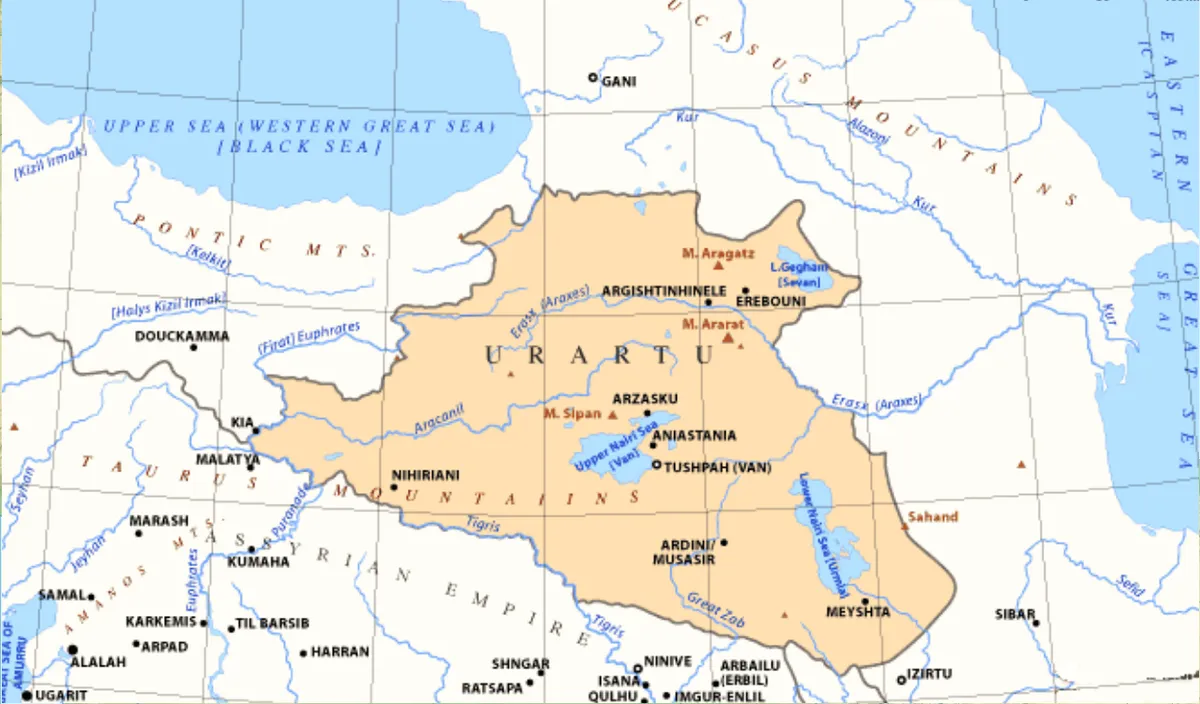
It was in the 9th century BCE, around 860 BCE, that one of the most remarkable civilizations of the ancient Near East took shape on the Armenian Highlands: Urartu. Referred to as Biaineli by its own rulers in their inscriptions, this state found its geographic cradle in the heart of the region's great mountain ranges and lake basins, around Lakes Van, Urmia, and Sevan.
The earliest mentions of this land come from Assyrian annals. As early as the 13th century BCE, under Shalmaneser I, Mesopotamian texts record military campaigns against the eight lands of "Uruatri," described as a confederation of principalities. Shalmaneser I's successor, Tukulti-Ninurta I, used the term "land of Nairi," a designation later taken up by Tiglath-Pileser I, who claimed to have fought "60 kings of Nairi." Faced with repeated pressure from the Assyrian Empire to the south, these various tribal entities gradually coalesced. This process of political unification culminated under the leadership of Arame (c. 860–843 BCE), the first attested king of Urartu, whose centers of Sugunia and Arzashkun were attacked by Shalmaneser III.
A new dynasty then emerged with Sarduri I, son of Lutipri, around 832 BCE. This monarch established the royal capital at Tushpa (modern-day Van), on the eastern shore of Lake Van. At the foot of the imposing Rock of Van, he erected a massive wall of cyclopean masonry bearing inscriptions in Akkadian, in which he claimed the titles of "great king" and "king of Nairi."
The Military and Territorial Zenith of Biaineli
Under the successive reigns of Ishpuini and his son Menua, at the turn of the 9th and 8th centuries BCE, the kingdom transformed into a major expansionist power. Ishpuini incorporated the holy city of Musasir (Ardini), a cultic center dedicated to Haldi, who subsequently became the supreme deity of the Urartian pantheon. It was also during his reign that the rulers adopted their own language for official cuneiform inscriptions, abandoning the exclusive use of Assyrian.
Menua (c. 810–786 BCE) consolidated these conquests by leading his armies toward the Upper Euphrates, the region of Melid, and the fertile Araxes Valley to the north. His successor, Argishti I (c. 786–764 BCE), brought the kingdom to its peak. As documented by his annals carved into the rock at Van, Argishti I advanced into the Caucasus and subdued vast territories. In 782 BCE, he founded the renowned fortress of Erebuni—the direct ancestor of Armenia's modern capital, Yerevan—where he settled 6,600 prisoners and warriors originating from the lands of Hatti and Supani.
Urartu thus became the foremost political power in the Near East. At its maximum extent under Argishti I and Sarduri II, its authority reached from the foothills of the Caucasus and southern Georgia to the sources of the Tigris, and from the Upper Euphrates to the east of Lake Urmia. In 753 BCE, Sarduri II inflicted a crushing defeat on the Assyrian king Ashur-nirari V. However, Assyria's military revival under Tiglath-Pileser III in 743 BCE at Samosata, followed by the eighth campaign led in 714 BCE by Sargon II—marked by the brutal sack of the sanctuary of Musasir—brought an end to the southern ambitions of Rusa I.
Architectural Mastery, Metallurgy, and Spiritual Life
Urartian civilization was characterized by defensive urban planning adapted to the harsh terrain. Kings erected imposing fortresses of dressed stone and mudbrick perched on rocky outcrops, such as Teishebani (Karmir Blur), Argishtihinili (Armavir), Altintepe, Bastam, and Ayanis. To sustain this agricultural economy within narrow valleys, the monarchs developed monumental irrigation networks. The Menua Canal, stretching over 50 kilometers, conveyed fresh water from south of Lake Van to Tushpa and remains in use today.
Archaeological excavations have also revealed the extraordinary sophistication of Urartian bronze artisans. Working with the lost-wax technique, metallurgists crafted large ritual cauldrons with figurative attachments, shields adorned with concentric registers of lions and bulls, and richly engraved conical helmets. The citadels of Erebuni and Teishebani have preserved vivid polychrome frescoes depicting royal hunting scenes and sacred figures, such as an Erebuni fresco showing a figure wearing the soft conical cap characteristic of the highland populations.
Religious life was centered around a dominant triad: the supreme god Haldi, Teisheba (god of storms and war), and Shivini (the sun god). Their cults and sacrificial prescriptions were recorded on the major rock inscription of Meher Kapisi ("Mher's Door"), near the fortress of Van.
From Modern Rediscovery to Historical Continuities
Forgotten by classical Greek authors, Urartu survived in textual memory through the Bible, which mentions the kingdom or land of Ararat. The medieval Armenian historian Moses of Chorene recorded the tradition of monumental works built on the shores of Lake Van, which he attributed to Ara the Beautiful and Queen Semiramis. Modern archaeology began in 1827 when the Société Asiatique of Paris dispatched the scholar Friedrich Eduard Schulz, who copied the first cuneiform inscriptions at Van and identified the bilingual Kelashin Stele prior to its publication in 1840. In the 20th century, systematic excavations conducted by Boris Piotrovsky at Karmir Blur from 1939 onward, and later at the site of Arin Berd (Erebuni), revealed the full scale of this material culture.
Epigraphic sources shed remarkable light on the transition from Urartu to Armenia. On the trilingual Behistun Inscription, carved around 520 BCE under the Persian king Darius I, the Babylonian toponym Urashtu (derived from Urartu) is translated into Old Persian as Armina (Armenia), and the Babylonian term urartaya corresponds strictly to arminiya ("Armenian"). Far from abruptly vanishing following the Scythian and Median incursions of the early 6th century BCE, major fortresses such as Erebuni, Körzüt, Aramus, and the rock of Aralesk/Kalecik bear witness to continuous occupation under the Armenian Orontid dynasty and through the Achaemenid period, preserving across centuries the heritage of one of the most illustrious empires of the highlands.
Sources
- Urartu (Wikipedia fr)
- Urartu (Wikipedia en)
- Վանի թագավորություն (Wikipedia hy)
- Урарту (Wikipedia ru)
- The Myth of Urartu’s Collapse: Archaeology Shows a 3,000-Year Continuum (PeopleOfAr)
- The Floppy Hats of Urartu (PeopleOfAr)
Texts from Wikipedia (CC BY-SA 4.0) and Wikisource (CC BY-SA 3.0), used as sources.
Written with an AI tool from the sources cited and checked by our editors; translated automatically from the reviewed French text.
Read next
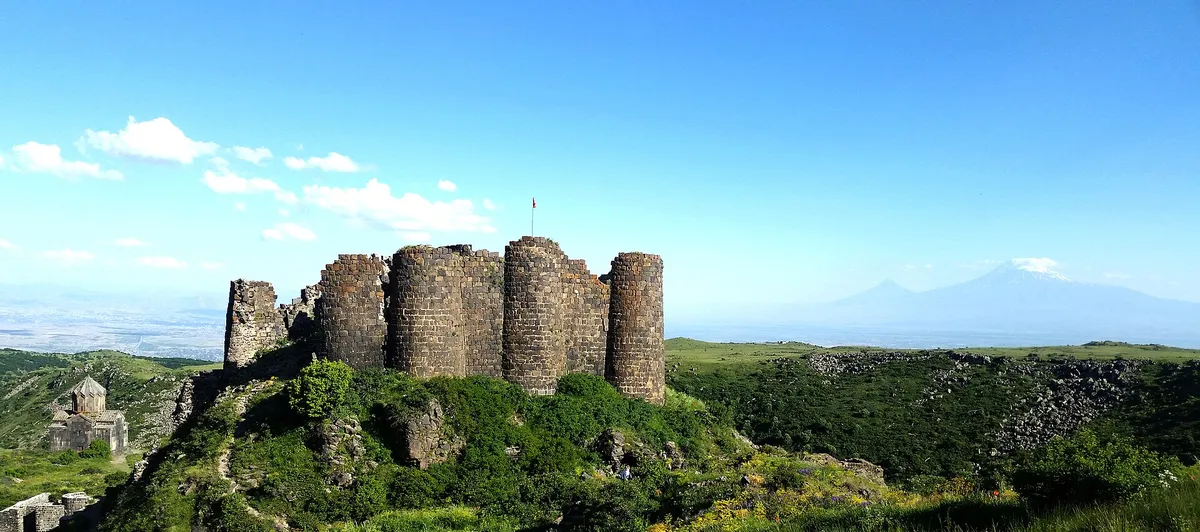 Amberd, the Millennial Sentinel Standing on the Slopes of Mount AragatsPerched at 2,300 meters, the medieval fortress of Amberd and its church bear witness to the military and architectural grandeur of ancient Armenia.
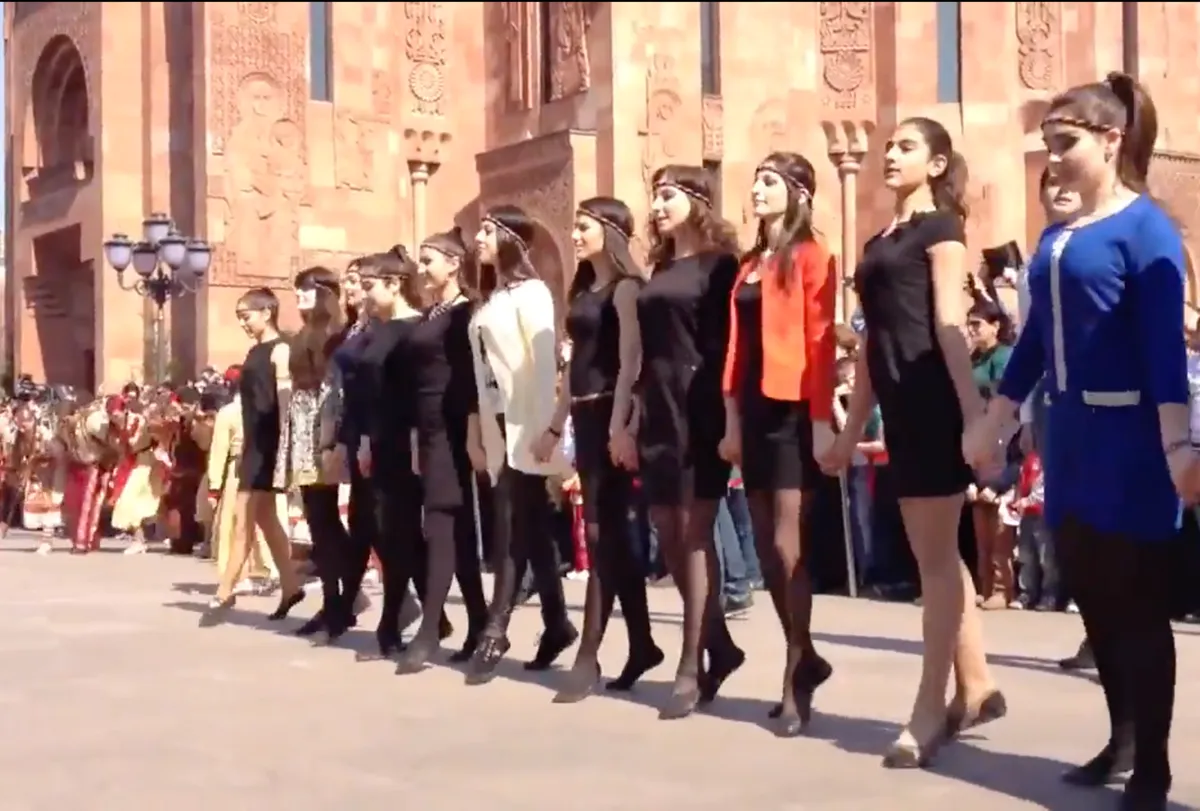 Kochari: History, Steps, and Memory of an Emblematic DanceDiscover Kochari, a circle dance born in the Armenian highlands, from its unique movements to its inscription on UNESCO's cultural heritage list.
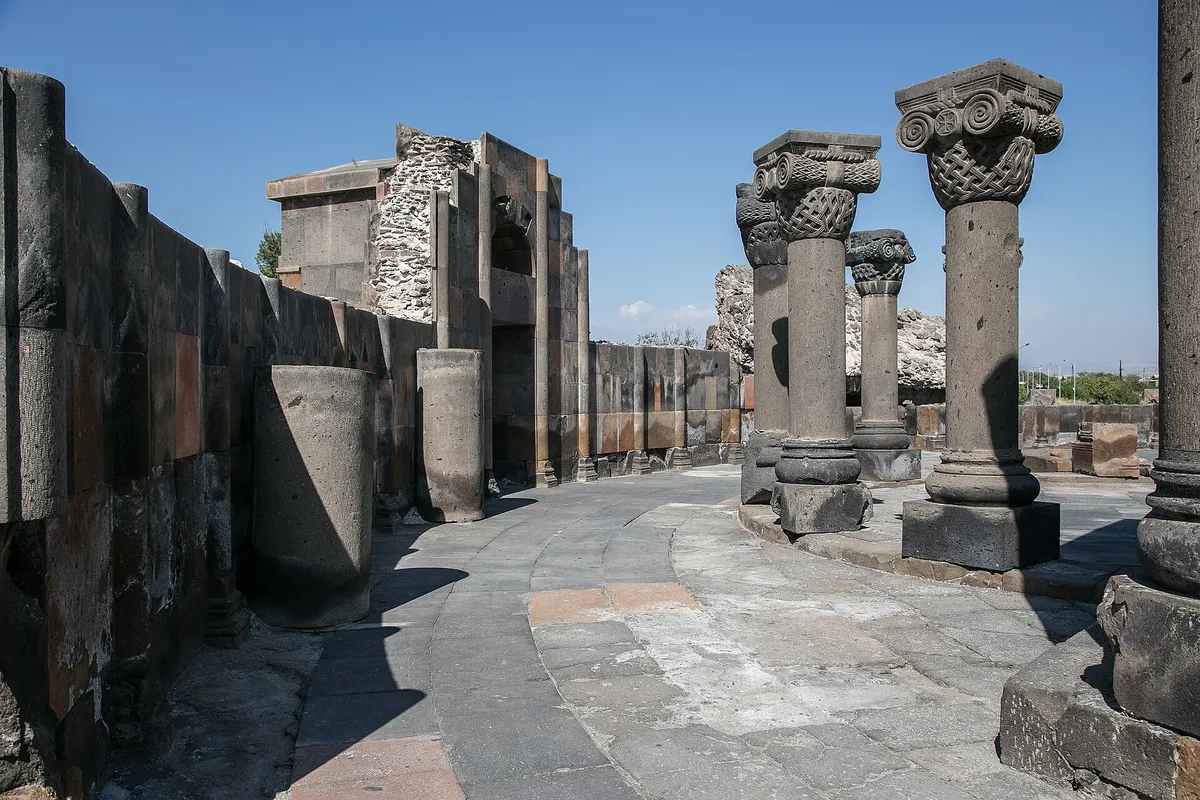 Zvartnots: The Shattered Masterpiece of Armenian ArchitectureBuilt in the 7th century by Catholicos Nerses III, the circular cathedral of Zvartnots remains an exceptional milestone of medieval Armenian art.