Moses of Chorene: The Founding Father of Armenian Historiography
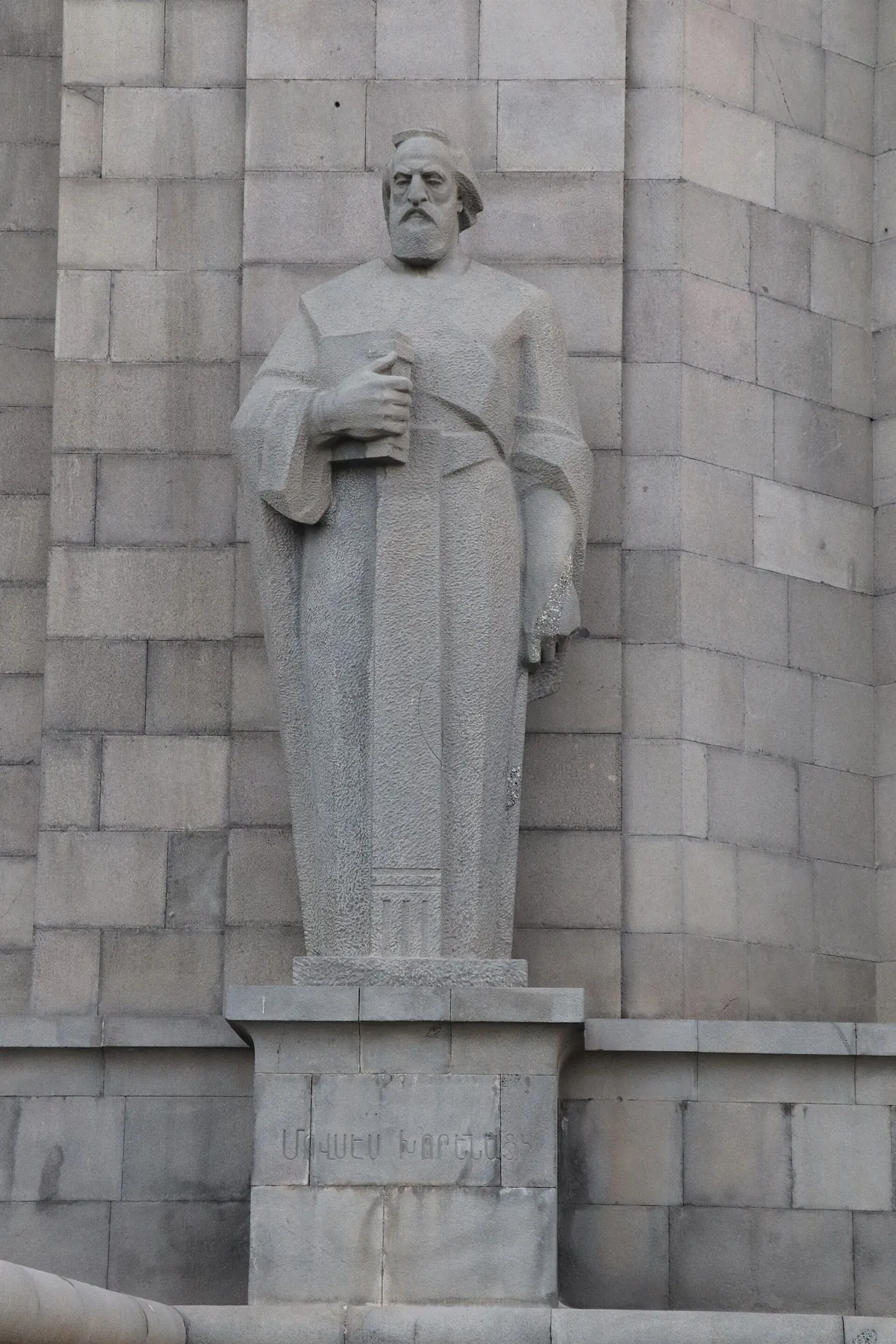
In the memory and letters of Armenia, one voice resonates with singular majesty: that of Moses of Chorene (Movses Khorenatsi). Revered under the title of Patmahayr ("father of Armenian history") and often called the "Armenian Herodotus" or Kertoghahayr, this great 5th-century intellectual shaped the first continuous and reasoned history of his nation. At a time when the country was undergoing profound political transformations, his work became the cornerstone of Armenian identity and national consciousness.
Paths of Knowledge: From Syunik to the Great Centers of the Mediterranean
Born around 410, Moses has his place of origin divided by tradition between the village of Khoronk (or Khorni) in Taron and the locality of Khorea located in the canton of Haband, in Syunik, as later suggested by the historian Stepanos Orbelian and the philologist Stepan Malkhasyants. Educated from childhood in the schools founded by Mesrop Mashtots, the inventor of the Armenian alphabet, the young scholar subsequently joined the center of learning in Vagharshapat. There, under the joint tutelage of Mashtots and Catholicos Sahak I, he became acquainted with the Greek, Syriac, and Pahlavi languages.
Following the Council of Ephesus held in 431, as the fathers of the Armenian Church worked to perfect the Armenian version of the Holy Scriptures, Moses was among the brilliant disciples sent abroad to further their education. Between 432 and 435, he left his native land. This intellectual journey first took him to Edessa and Palestine, before he settled for several years in Alexandria, a radiant metropolis where he assimilated rhetoric, grammar, theology, and philosophy. He then traveled to Europe via Rome and Athens, before returning to Armenia after 440.
The return, however, was marked by sorrow: his revered masters, Sahak Partev and Mesrop Mashtots, had passed away shortly before his arrival, while the royal Arsacid dynasty had fallen under Sasanian rule in 428. Faced with an atmosphere of mistrust and persecution, Moses settled into studious solitude near Vagharshapat. He emerged decades later when Catholicos Giut, who had been his fellow student, recognized him, welcomed him warmly, and elevated him to the dignity of bishop of Bagrevand.
The "History of Armenia": Genesis of a Masterpiece
It was at the pressing request of Prince Sahak Bagratuni—who would perish in 482 at the Battle of Charmana—that the bishop undertook the writing of his magnum opus: the History of Armenia (Patmutyun Hayots), probably completed around 474 or 480. Addressing this patron, the historian formulated one of his most famous thoughts, recalling that even though the Armenian people are small in number and often dominated by powerful empires, countless acts of bravery performed on their land deserve to be immortalized in writing.
Composed of three books, the work embraces the Armenian trajectory from legendary beginnings up to the 5th century:
- Book One: the genealogy of Greater Armenia, linking the Armenians to the biblical lineage of Noah through the tutelary figure of Hayk, mentioning King Aram and the monarch Paruyr Skayordi, as well as the Yervanduni dynasty. - Book Two: intermediate history, from the rise of the Arsacids after Alexander the Great to the reign of Tiridates the Great and the proclamation of Christianity. - Book Three: contemporary times and political decline up to the fall of the monarchy in 428 and the successive deaths of Sahak I and Mashtots.
This third book concludes with the famous "Lament" (Voghp), a text of striking poetic intensity in which the author mourns the collapse of national sovereignty, the loss of his spiritual fathers, and the misery of a country stripped of its traditional bearings.
Methodological Rigor and Poetic Breadth
Moses of Chorene distinguished himself through his demanding vision: "History without chronology is not true," he professed. He established a rigorous framework integrating Armenian, Persian, and Roman rulers, guided by three imperatives: fidelity, conciseness, and persuasion. To build this monument, he drew upon archives, Greek and Armenian historians (Agathangelos, Koryun, Lazar Parpetsi, Eusebius of Caesarea, Herodotus), as well as the writings of the Syrian Mar Abas Catina.
His most precious contribution lies in the preservation of pagan oral heritage. By listening to the gusans, the traditional minstrels of ancient Armenia, Moses recorded mythological and epic tales unique in the world, such as the tragic love of Artashes and Satenik or the song celebrating the birth of the god Vahagn.
Beyond his major historical narrative, tradition attributes to Moses of Chorene prominent liturgical hymns (sharagans) still sung in the Armenian Apostolic Church, such as Khorhurd mets yev skancheli, as well as rhetorical treatises, panegyrics dedicated to Saint Hripsime, and the translation of the Romance of Alexander attributed to Pseudo-Callisthenes.
Legacy and Modern Perspective
Preserved in some twenty medieval manuscripts—the most venerable of which are housed at the Matenadaran in Yerevan or kept in Venice and Vienna—the History of Armenia served as a standard reference textbook until the 18th century. Beginning in the mid-19th century, Western historians such as Alfred von Gutschmid, and later Robert Thomson in the late 20th century, initiated a critical debate regarding its dating, proposing a later composition between the 7th and 9th centuries due to certain formulations and anachronisms. Scholars such as Stepan Malkhasyants, Manuk Abeghian, and Gagik Sargsyan defended Moses’s 5th-century origins, explaining the presence of later elements as scribal interpolations over the centuries.
Furthermore, several of Khorenatsi's descriptions have been confirmed by modern science: it was reading his accounts of the city of Van and its cuneiform inscriptions that led to the expedition of Friedrich Eduard Schulz and the rediscovery of the Urartian language, while the boundary stones inscribed by King Artashes have been authenticated by archaeology.
Dying around 490, Moses of Chorene remains one of the greatest symbols of national heritage. In tribute to this literary pioneer, the Republic of Armenia established the prestigious Movses Khorenatsi Medal in 1993, honoring creators and scholars who, in his image, continue to enrich Armenian culture and humanities.
Watch the video
Sources
- Moïse de Khorène (Wikipedia fr)
- Movses Khorenatsi (Wikipedia en)
- Մովսես Խորենացի (Wikipedia hy)
- Мовсес Хоренаци (Wikipedia ru)
Texts from Wikipedia (CC BY-SA 4.0) and Wikisource (CC BY-SA 3.0), used as sources.
Written with an AI tool from the sources cited and checked by our editors; translated automatically from the reviewed French text.
Read next
 Hovhannes Toumanian, the Fraternal and Immortal Voice of Armenian LettersA look back at the life and work of Hovhannes Toumanian (1869–1923), Armenia's national poet, founder of Vernatun, and tireless protector of his people.
 Kochari: History, Steps, and Memory of an Emblematic DanceDiscover Kochari, a circle dance born in the Armenian highlands, from its unique movements to its inscription on UNESCO's cultural heritage list.
 Martiros Saryan, the Master Who Painted the Soul and Light of ArmeniaA founding figure of modern Armenian painting, Martiros Saryan devoted his life to capturing the light of his homeland and building its cultural rebirth.