Arno Babajanian: The Vibrant Breath of an Armenian Master Between Classical and Popular Melody
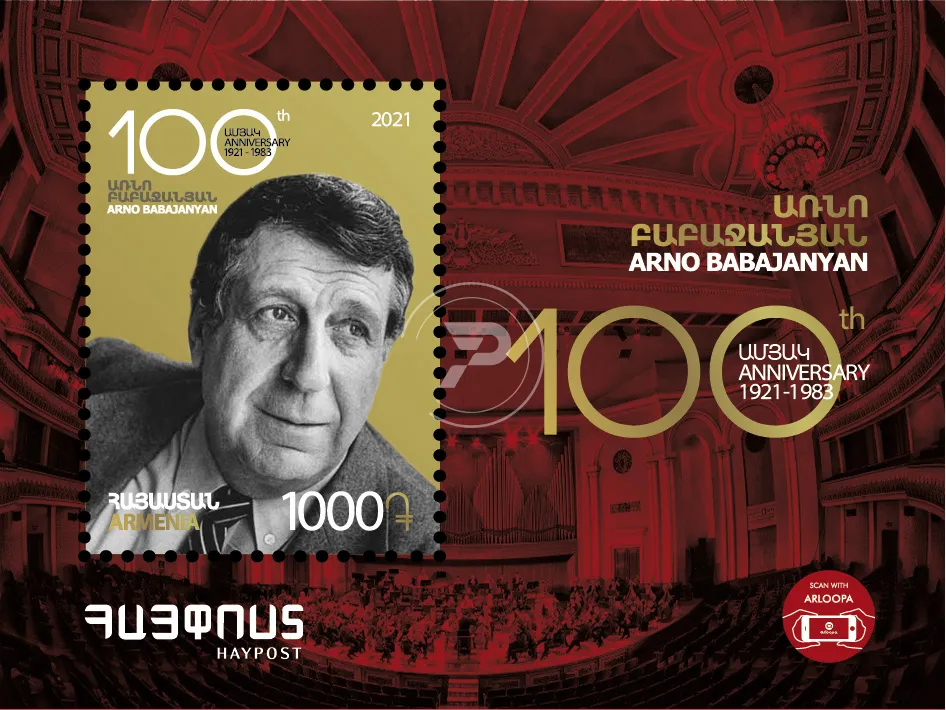
Born in Yerevan on January 22, 1921—his father having registered this date following the death of Lenin on January 21—Arno Babajanian established himself as one of the most singular and warm-hearted personalities in the Armenian and Soviet musical landscape. A virtuoso pianist praised in his time by Dmitri Shostakovich as a "brilliant piano teacher," he succeeded in creating a dialogue between Armenian modal and folk traditions, the romantic virtuosity of a Rachmaninoff, and the expressive daring of his century. Passing away on November 11, 1983, in Moscow from leukemia, and now resting in Yerevan at the Tokhmakh cemetery, Babajanian left behind a luminous body of work where the most demanding chamber music stands alongside symphonic pages and songs hummed by entire generations.
Exceptional Training and Early Fervor
Arno Babajanian's musical awakening took root in an attentive household where his father, a mathematics teacher, played various traditional Armenian instruments, and his mother taught Russian. From the age of three, the child tried his hand at the family harmonium. Two years later, while having fun at the piano in a kindergarten keeping time to the rhythm, he caught the attention of Aram Khachaturian, who immediately advised that he receive serious training.
In 1928, he joined the group of gifted children at the Yerevan Conservatory while attending the Gorky School. At age nine, he composed his Pioneers' Waltz, published in 1932 as a march. At age twelve, performing Beethoven's Fourth Sonata and Mendelssohn's Rondo capriccioso, he won first prize at the Young Musicians of Armenia competition. He then studied with Sargis Barkhudaryan and V. Talyan, before continuing his studies in Moscow in 1938 at the Gnessin School under Elena Gnessina and Vissarion Shebalin. Despite the interruption of the war—during which he participated in defensive works near Smolensk and then in the evacuation of the Moscow Conservatory to Saratov—he perfected his craft with Konstantin Igumnov and Boris Berlin, while working at the Armenian House of Culture in Moscow with Heinrich Litinsky. Babajanian forged unbreakable bonds with his colleagues Alexander Arutiunian, Edvard Mirzoyan, and Ghazaros Saryan, forming what history remembers as the "Armenian Mighty Handful."
Masterpieces of Chamber and Concert Music
Upon returning to Armenia, where he taught piano at the Yerevan Conservatory from 1950 to 1956 before receiving the title of associate professor (docent) and moving to Moscow, Arno Babajanian asserted a striking musical language. In 1950, his Heroic Ballade for piano and orchestra met with resounding success, earning him the Stalin Prize (Third Class) in 1951. That same year, in close collaboration with Alexander Arutiunian, he composed the celebrated Armenian Rhapsody for two pianos, followed in 1960 by the Festive Pieces with percussion.
The year 1952 saw the creation of his Piano Trio in F-sharp minor, unanimously celebrated from its premiere and recorded notably alongside violinist David Oistrakh and cellist Sviatoslav Knushevitsky. In 1958, he completed his Sonata for Violin and Piano, dedicated to Shostakovich, and then conceived his Cello Concerto (1962), dedicated to his friend Mstislav Rostropovich. His Six Pictures for solo piano (1963–1964), awarded the State Prize of the Armenian SSR in 1967, innovatively blend traditional intonation with serial techniques. In 1965, his Poem for piano was chosen as the compulsory piece for the second round of the prestigious 1966 International Tchaikovsky Competition. Performed by masters such as Emil Gilels, Lev Vlassenko, Medea Abrahamyan, Svetlana Navasardyan, and Jean Ter-Merguerian, his instrumental works remain a pinnacle of Armenian modernity.
A Master of Melody and Cinema
Arno Babajanian possessed the rare privilege of moving audiences just as deeply in great philharmonic halls as on popular radio airwaves. The composer of more than two hundred songs, he achieved immense renown starting in 1958 thanks to the score for the film The Song of First Love, which became an anthem to the Armenian capital. His film catalog was subsequently enriched with memorable scores for Bride from the North (1975), My Heart Is in the Highlands (1975), Baghdasar's Divorce (1976), and The Mechanics of Happiness (1982), which earned him a posthumous State Prize.
Working with major poets such as Robert Rozhdestvensky, Yevgeny Yevtushenko, and Andrei Voznesensky, he gave birth to universally broadcast titles such as Nocturne, The Wedding (Svadba), and The Best City on Earth (Luchshy gorod Zemli), brought to their peak by the voice of Muslim Magomayev. In 1973, his song Ferris Wheel won first prize at the Tokyo World Song Festival.
Keeping the Flame Alive in Madrid
Honored with the titles of People's Artist of the Armenian SSR in 1962 and People's Artist of the USSR in 1971, and recipient of the Order of the Red Banner of Labor (1956) and the Order of Lenin (1981), Babajanian left an immortal legacy. In Yerevan, where a statue depicting him at the keyboard was erected in the city center and a concert hall bears his name, his music continues to resonate as the dazzling expression of his country's soul.
This heritage will continue to shine on international stages during the concert by the "Duo Tanja Becker-Bender, violin & Sofya Melikyan, piano", which will take place on December 2, 2026, in the Community of Madrid. A special opportunity to rediscover the intensity and ardent lyricism of a repertoire where violin and piano engage in dialogue at the highest level of expression.
Watch the video
Don’t miss : Duo Tanja Becker-Bender, violin & Sofya Melikyan, piano — Wednesday, December 2, 2026, Communauté de Madrid
Sources
- Arno Babadjanian (Wikipedia fr)
- Arno Babajanian (Wikipedia en)
- Առնո Բաբաջանյան (Wikipedia hy)
- Бабаджанян, Арно Арутюнович (Wikipedia ru)
Texts from Wikipedia (CC BY-SA 4.0) and Wikisource (CC BY-SA 3.0), used as sources.
Written with an AI tool from the sources cited and checked by our editors; translated automatically from the reviewed French text.
Read next
 William Saroyan, the Warm and Universal Voice of Armenian MemoryFrom the San Joaquin Valley to Broadway stages, William Saroyan built a body of literary work deeply rooted in his heritage and the Armenian soul.
 Kochari: History, Steps, and Memory of an Emblematic DanceDiscover Kochari, a circle dance born in the Armenian highlands, from its unique movements to its inscription on UNESCO's cultural heritage list.
 Djivan Gasparyan and the Universal Breath of the Armenian DudukA look back at the life and career of Djivan Gasparyan, the duduk master who brought Armenian music to major world stages and international cinema.