The Art of Khachkars: When Armenian Stone Becomes the Tree of Life
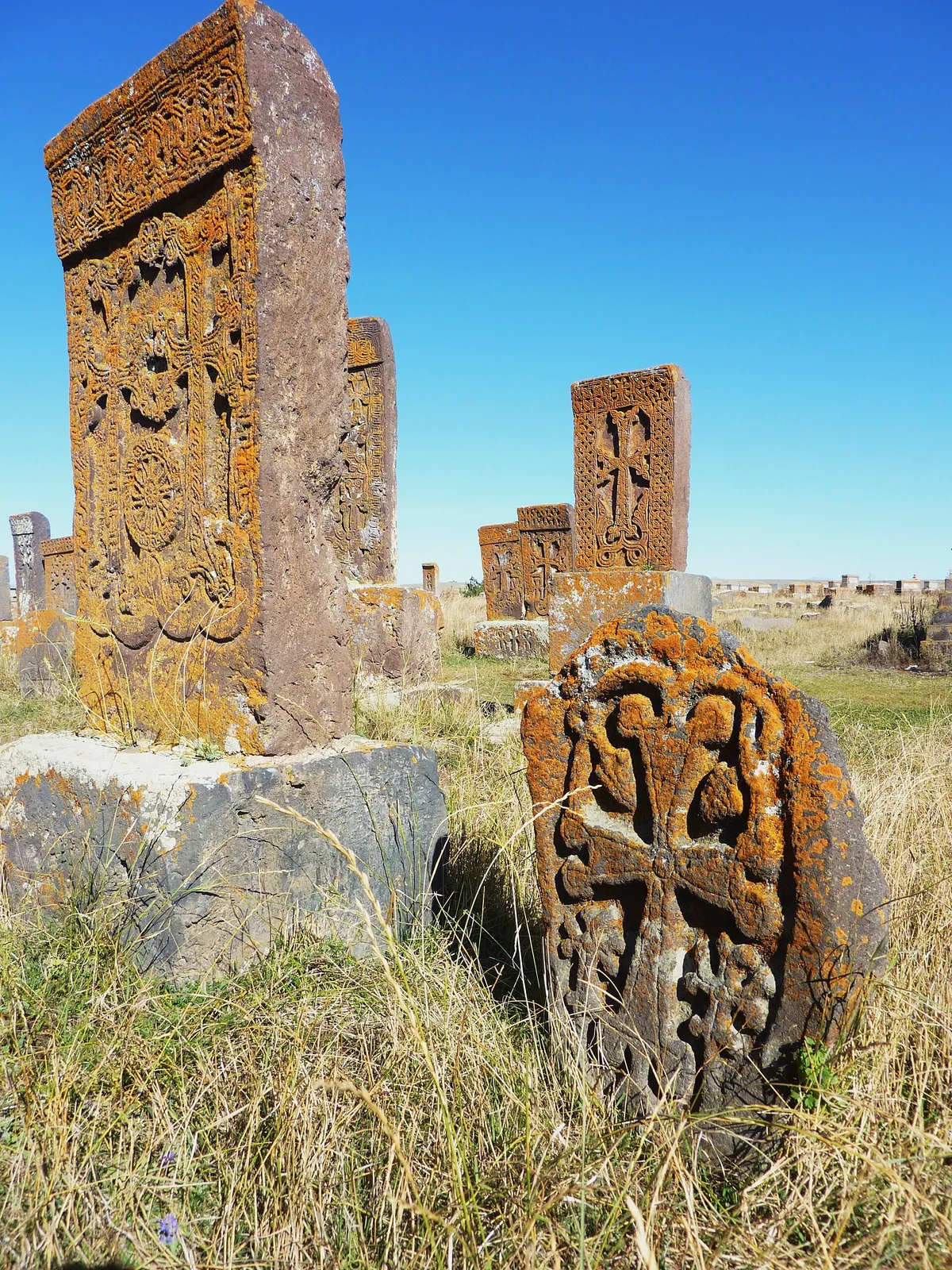
An emblematic hallmark of Armenian art, the khachkar (in Armenian xač‘k‘ar, composed of xač‘, cross, and k‘ar, stone) does not translate as "stone cross", but quite precisely as "cross-stone". This linguistic nuance reflects its material reality: it is a rectangular or arched stele, generally carved from a local rock such as tuff, basalt, andesite, or sandstone, featuring one or more crosses carved in bas-relief on its west-facing side.
Erected in the open landscape, mounted on a pedestal with a tenon, embedded in the walls of sanctuaries, or carved directly into rock, these works most often measure between 1.5 and 2 meters in height. They have endured through the centuries as witnesses to the faith, history, and identity of the Armenian people.
A Tree of Life: Theology Carved into Matter
The khachkar embodies the Christology specific to the Armenian Apostolic Church, as defined in the 8th century under Catholicos Hovhannes III of Odzun. Unlike the tradition of other Christian confessions, the stele does not depict the torment or bodily death of Christ, but asserts his divine nature and his victory over death. The medieval jurist Mkhitar Gosh already emphasized this distinction, noting that while others honor images, Armenians venerate the cross.
The Armenian cross thus becomes a true tree of life, a celestial sign named nšan. Its arms flare into vegetal shapes, while its base unfurls symmetrical leaves that curl into volutes. In the composition, the stele establishes a vertical bridge: the lower section, associated with the earthly world, the past, and human life, joins the upper celestial and divine realm. Clusters of grapes, pomegranates, and intricate networks of continuously carved interlace create an illusion of infinity. In popular belief, the khachkar is even reputed to house a fragment of the True Cross.
While most stelae serve a votive function—seeking salvation for the souls of the donor and their loved ones—others commemorate a founding, a religious construction, or a military victory. More rarely, some have an apotropaic role (tsasman), erected to ward off demons or protect against natural disasters.
From the Bagratids to the Medieval Golden Age
The history of cross-stones unfolds across four major phases. The roots of the standing stele lie in a long continuity dating back to vishap stones, columns, and pre-Arab monuments. However, true khachkars appeared in the 9th century, driven by the national revival under the Bagratid dynasty following liberation from Arab rule. One of the oldest surviving dated examples was erected at Garni in 879 by Queen Katranide, wife of King Ashot I, echoing other early examples such as the one in Hortun (876) or the base found in the Martakert region (853).
The art of the khachkar reached its zenith between the 12th and 14th centuries. During this period of exceptional technical virtuosity, master craftsmen wielded the drill and chisel with lace-like precision. Famous signatures emerged, such as those of Timot and Mkhitar at Geghard (1213), Poghos at Goshavank (1291), Momik in Vayots Dzor, and Vahram at Haghpat (1273). The latter crafted a remarkable Amenap‘erkič‘ ("Savior of All"), a rare type depicting the crucifixion or descent from the cross, to which popular devotion attributed curative powers.
Regional workshops asserted their distinctive traits: the Artsakh school, for instance at Dadivank and Gtichavank, featured crosses pattée against a background of foliage rinceaux in fine tuff. After a slowdown caused by the Mongol invasions, the art experienced a revival in the 16th and 17th centuries, notably exemplified by works from Syunik or the slender khachkars of the great cemetery of Julfa.
An Endangered Heritage Recognized by UNESCO
Over the centuries, the khachkar also served as written memory. Its careful inscriptions in uncial script (erkatagir), sometimes carved in relief, record the identities of sculptors, the year of erection, or donations, forming valuable historical and linguistic records.
Once scattered throughout historic Armenia, these works have suffered immense losses. Between 1998 and 2005, the medieval cemetery of Julfa in Nakhchivan, which contained several thousand red tuff stelae, was completely destroyed and razed during a planned operation by the armed forces of Azerbaijan. Khachkars are also the target of systematic destruction in Nagorno-Karabakh by Azerbaijan. In Turkey, few specimens have survived the systematic eradication underway since the Armenian Genocide. Damage and attempts at cultural erasure have also been noted in Georgia, in the Javakheti region.
To protect and honor this heritage, UNESCO inscribed "Armenian cross-stones art. Symbolism and craftsmanship of Khachkars" on the Representative List of the Intangible Cultural Heritage of Humanity on November 17, 2010. In the Republic of Armenia, where tens of thousands of specimens survive—including the remarkable gathering at the Noratus cemetery on the shores of Lake Sevan—khachkars are classified by law as inalienable cultural property.
A Living Tradition Resonating as Far as Auvergne-Rhône-Alpes
Far from being an extinct craft, the creation of khachkars has revived since the 1960s. Contemporary craftsmen perpetuate this stone carving passed down through generations, and the Armenian diaspora has scattered these stelae across the globe, notably to pay tribute to the departed and in memory of the victims of the genocide. In France, nearly thirty khachkars stand in public spaces.
This enduring tradition continues to leave its mark on memories and the land. Those attached to this millenary culture are invited to a solemn and fraternal gathering: the "Blessing of the KHACHKAR in Saint-Chamond" ceremony, which will take place on October 18, 2026, in the heart of the Auvergne-Rhône-Alpes region.
Don’t miss : Bénédiction de KHATCHKAR à Saint-Chamond — Sunday, October 18, 2026, Auvergne-Rhône-Alpes
Sources
Wikipedia texts under the CC BY-SA 4.0 licence, used as sources.
Written with an AI tool from the sources cited and checked by our editors; translated automatically from the reviewed French text.